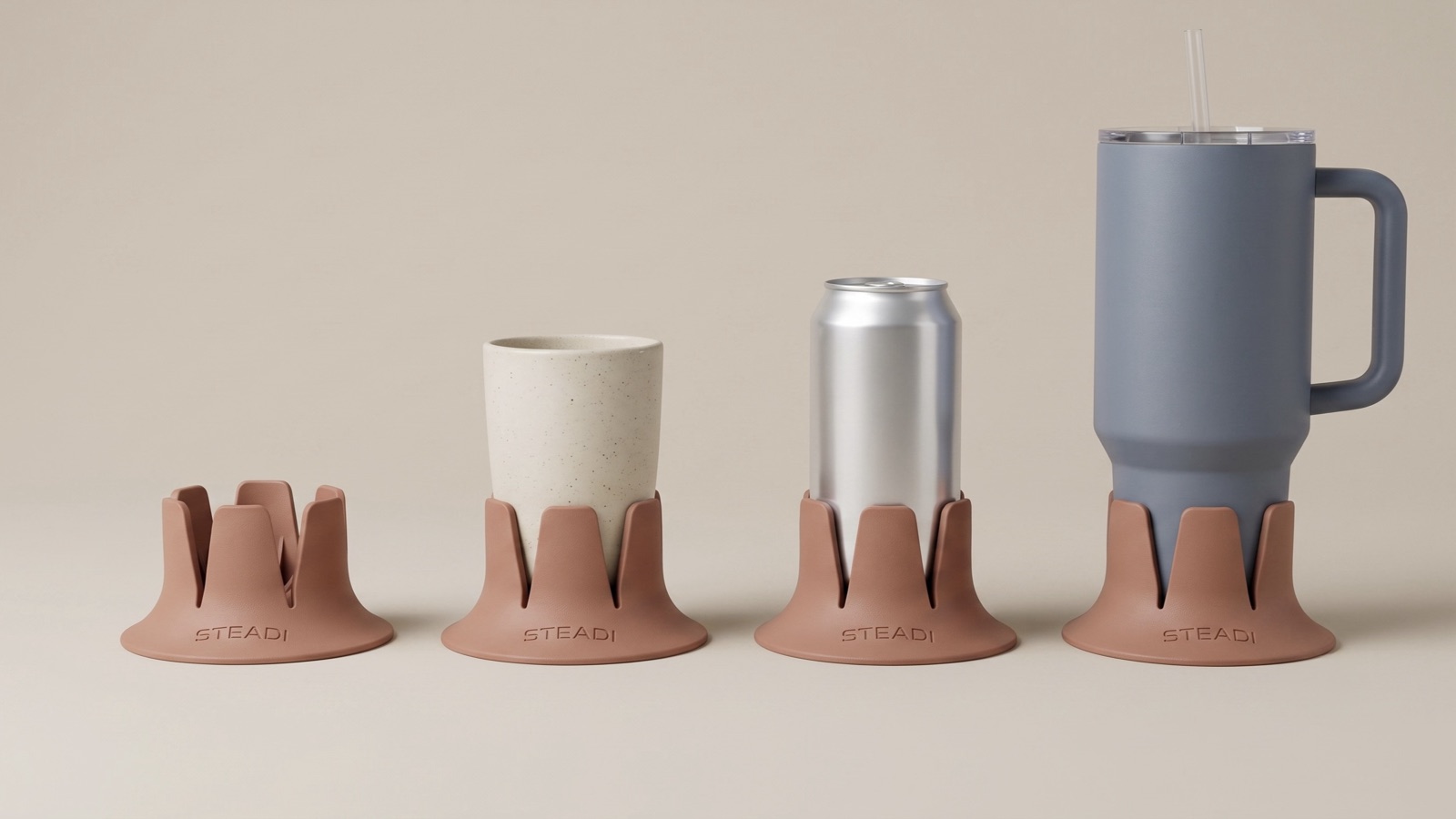
Finally, somewhere to put your drink that isn't the rail.
A flexible base that grips your pint, longneck, or 40 oz tumbler and holds it steady on the high-top or the wall shelf — whichever side of the table you're shooting from — so the drink stays in reach and the cloth stays out of the story.
One flexible base. First empty, then a cup, a can, and a 40 oz tumbler — the same fins around each one, and none of it anywhere near a rail.
The situation
The only surface always in reach is the one the house rules ban.
Pool is played from all four sides of the table, and every legal place to set a drink down lives on just one of them. So the cup drifts, all night, toward the ledge it's not supposed to touch.
The rail.
A flat wooden ledge at natural set-a-glass-down height, bordering the cloth on all four sides — which is exactly why every etiquette guide bans it. A tip pours straight onto the playing surface, a sweating glass rings the finish, and the forum threads about lifting beer stains out of cloth are proof of how the rule usually ends.
The high-top between tables.
One small bar-height round absorbing four players' cue cases, chalk, phones, score sheets, and pints. It stands inside the swing zone where backswings and celebration elbows travel — and a knock at bar height falls far and splashes wide.
The wall shelf.
The narrow ledge the etiquette guides point to instead. Drinks wait there single file while passing players, leaned cues, and jackets brush by — and it's never on the side you're shooting from, so the cup migrates back toward the rail.
The spectator chair arm.
A flat armrest — sometimes with a shallow turned recess that locates a glass without holding it — under a spectator who twists to follow every shot. It only serves whoever's sitting; the moment you're up to shoot, you're improvising again.
The floor by the table leg.
The overflow spot once every ledge is full. The room is lit hard over the cloth and dim everywhere else, which parks bottles at ankle height exactly where a player stepping backward to line up the next shot is looking least.
None of these is a real answer. That's why the drink keeps circling back to the one ledge that's always within arm's reach — the one that borders the cloth.
You know the moment
Every pool room has these same four minutes.
League night, hill-hill
The shared high-top has disappeared under cue cases, score sheets, and a row of pints. The last ball drops, hands come out for the shake — and somebody's follow-through, or the handshake itself, finds the glass parked nearest the edge.
Mid-rack, the long stretch shot
You're bridged out across the table, one foot off the floor, hip past the rail. The backswing clears the cloth exactly as planned — and sweeps through the airspace over the pub table behind you, where three drinks are standing.
Saturday night, home table
A guest sets a sweating glass on the rail — just for one shot. The ring in the finish doesn't leave, and if the glass had gone the other way, the quote to make the cloth right again starts in the hundreds.
Between innings
Your opponent's at the table, so you run the loop: chalk up, sip, wait. The chalk cube lives on the rail, your cup wants to live beside it, and every trip back to your drink is another trip to the edge of the cloth.
What you get
Three reasons it stays out.
01
Holds its ground where elbows swing
On a hard tabletop the wide footprint plants and the fins take the drink by its bottom inch, so a glancing bump nudges the whole base instead of sending a pint skating on its own condensation. Knocked off level, it settles back.
02
Plays all four sides of the table
The cue rack's drink rings are bolted to one wall and the spectator chair only serves the sitter. This weighs almost nothing to move — set it on the shelf or the high-top on whichever side you're shooting from, and when the game turns you around, it comes along.
03
Gives the house rule its missing half
"No drinks on the table" has never come with an answer for where they should go. This is the answer: the glass stands gripped on a surface that's allowed, its sweat lands on molded material instead of the wood, and the rail goes back to holding chalk.
The fit test
The fit test is faster than a rack of balls.
your cup's base lands in here
A square sticky note: 3 inches, exactly.
01
Peel off a sticky note.
The classic square measures exactly 3 inches on a side. That's a plain fact about sticky notes — and it happens to be the exact ceiling of what the fins can take.
02
Stand your glass on it.
Judge the bottom, not the mouth. A shaker pint flares wide at the rim and narrows at the base; a longneck is all shoulders. The only measurement that matters is the ring touching the paper.
03
Call it.
Base inside the square: it fits. Hanging over the edges: too wide. A little island in the middle — under about 2 inches: too narrow for the fins to grip.
No calipers, no spec sheet, no guessing at the counter. One sticky note and the glass you actually drink from at the table, and you have your answer before the break.
Will it fit my cup
Measure the bottom, not the top.
One rule decides everything below: a container base about 2 to 3 inches across settles in. The floor counts as much as the ceiling.
Shaker pint of draft fits
Longneck bottle fits
Standard 12 oz can fits
Can in a foam koozie fits
Slim seltzer can fits
Rocks glass fits
40 oz Stanley-style tumbler fits
Disposable 16.9 oz water bottle fits
Plastic stadium cup fits
Paper coffee cup, lidded fits
Coffee mug, handled handle in the way
Shot glass too narrow
The floor is as real as the ceiling — under about 2 inches the base sits too loose in the fins, which is why the shot glass stays on the bar. And the handled mug from the home kitchen is the honest miss: its base fits, but the handle lands right where a fin needs to grip.
How it works
Three parts, no moving parts.
The footprint plants.
A glass concentrates all its weight on one narrow ring — easy to tip, easy to slide on a wet spot. The wide flexible base spreads that contact across the tabletop, so a graze pushes it, not over it.
The fins grip.
Flexible fins hold the container from the sides by its bottom inch — the grip a bare high-top never offers a sweating pint or a feather-light, half-empty can.
It settles.
A cue butt clips it, someone leans on the table, the whole high-top rocks — the base flexes, takes the hit, and brings the drink back level.
Nothing bolts to anything. No bracket on the wall, no clamp on the table, no furniture to park. It sits on whatever surface the room already has — high-top, wall shelf, chair arm, even the concrete by the table leg — and it's wherever the game needs it next.
Mind the cloth
In a billiard room, one surface makes the rules for all the others.
Drinks don't fail here because players are careless. The room is arranged around one surface that can't get wet, and every legal place to set a glass down is an afterthought at its edges.
The cloth
Worsted wool stretched over slate, and the most expensive consumable in the room. Care guides warn a spill can stain for good or soak through to the slate, and making it right runs into the hundreds. Players say cloth, not felt — and they mean it.
The rail
Flat finished wood at just the height a hand wants to drop a glass, bordering the cloth on every side. The room's most convenient shelf and its most banned: a tip pours straight onto the playing surface, and a cold glass rings the lacquer.
The high-top
Hard, flat, and stable on its own — the one honest surface in the room, which is why it's buried in gear. A free stroke with a full-length cue needs a wide berth, and the geometry of a nine-footer means the shared table ends up standing inside somebody's backswing.
The wall shelf
Elbow height, single file, in the walking lane. Passing players, leaned house cues, and shrugged-off jackets all travel the same strip of wall the drinks do — and it's fixed to one side of a game played from four.
The floor
Carpet or bare concrete in a room lit like a stage over the table and dim everywhere else. Bottles parked by a table leg sit at ankle height in the dark, in the path of players walking backward to see the next shot.
Versus what you do now
You've seen the fixes. They're all nailed down.
The cue rack with drink rings
Wall racks and floor racks come with molded drink holders built in — fixed to one wall or parked in one corner of a game played from four sides. And the rings are open recesses: they mark where a drink should stand without gripping it once it's there.
The spectator chair with armrest holders
Priced as furniture, parked against the wall, and useful exactly as long as you're sitting in it. The shallow recess turned into the arm is the same open-ring idea borrowed from old car consoles — it locates a glass, it doesn't hold on — and the moment you stand up to shoot, the drink problem is yours again.
Coasters on the rail
The standing forum advice for home tables, and it does stop rings in the finish. It does nothing about a knock, though — and it makes the drink's official home the one ledge every care guide says to keep drinks off of, one elbow from the cloth.
The house rule and the sign
"No food or drink on the table" hangs in every hall and heads every etiquette guide — and the beer-stain threads keep getting written anyway. A ban without an alternative doesn't move the drink; it just adds guilt to the rail.
Before you buy
Questions people actually ask.
Does it actually grip on a slick bar table?
Yes — hard, flat surfaces are home turf. The wide footprint spreads the contact so a bump shoves the base instead of tipping the glass, and the fins hold the drink by its bottom inch instead of letting it stand on its own sweat. Knocked off level, it settles back.
So can I finally put my drink on the rail?
Please don't — and you won't need to. The rule about the rail exists because it borders the cloth, and no holder changes that. What this does is make the surfaces you're allowed to use actually work: the high-top, the wall shelf, the chair arm. The drink stays in reach without touching the table at all.
Will my tumbler fit?
Look at the ring it stands on, not the rim you drink from. Bases about 2 to 3 inches across settle in, and the 40 oz Stanley is a confirmed yes. The handled mug from the kitchen is a no — the handle parks itself exactly where a fin has to grip.
Does anything mount to the table or the wall?
No. No brackets, no clamps, no screws. The room's existing drink holders are all fixed somewhere, and that's precisely their failure — this one sits on whatever surface is nearest, weighs next to nothing, and moves around the table as the game does.
League night is chaos. What happens when it gets bumped?
Bumps are the design brief. The flexible base takes the hit, flexes, and settles the drink back level — that's what resists tipping means in practice. It isn't magic: a full cue-butt strike is still a full cue-butt strike. But the brush-bys, the celebration elbows, and the table wobble are exactly what it's built to shrug off.
What about condensation? Cold glasses sweat hard in here.
The drink stands in the base, not on the wood, so the sweat runs down onto molded material instead of pooling on a finish. Rinse the base later — it's doing the coaster's job while it grips.
Can a spill still reach the cloth?
Honesty first: this resists tipping — it isn't a lid. It holds an open pint steady, settles it back when the surface gets bumped, and keeps the drink off the rail entirely, which is most of the battle. If you want a second layer over a Simonis-clothed table, pair it with a lidded tumbler.
Everything in a pool room wears chalk dust. How do I clean it?
Rinse it in the sink or run it through the dishwasher. It's one piece of flexible molded material — no seams or crevices for chalk dust to pack into.
I play at home and on a bar box in a league. Does it cover both?
It's the same problem in every version of the room. At home it lives on the wall shelf by the table; at the bar it plants on the high-top; on league night it rides in the gear bag next to the chalk.
Who makes it, and where do I buy one?
It's called the Steadi — injection molded in small runs in Orange, California, by Steadi Labs, veteran-founded and patent pending. Orders ship free from steadilabs.com, and you get 30 days to change your mind.
Who makes it
Made start to finish in Orange, California.
The maker is Steadi Labs, a small veteran-founded company in Orange, California. It's injection molded — the mold, the material, and the color runs all sit within about three and a half miles of the shop, and every batch is molded there in small runs. The people who make it are the same people who answer hello@steadilabs.com.
Thirty days, wherever you use it.
Use it for a month. If it doesn't do what this page says, email hello@steadilabs.com and it gets made right — no forms, no fight.
Veteran-founded · Patent pending · Made in Orange, California
Give the rail back to the chalk.
Your drink has a gripped spot on whichever side you're shooting from — in reach between innings, off the wood, and nowhere near the cloth.